Fagin
Fagin is the master criminal who orchestrates the pickpocketing ring that ensnares Oliver Twist, a figure of almost demonic cunning and avarice who operates from a filthy den in the London slums. He is the novel's primary antagonist, a manipulative old Jew who systematically corrupts children for profit, and his eventual trial and execution form the grim climax of Oliver's journey through the underworld. More than a mere villain, Fagin embodies the predatory logic of a society that devours its weakest members, making him a central figure in Dickens's indictment of institutional and moral decay.
Identity and Introduction
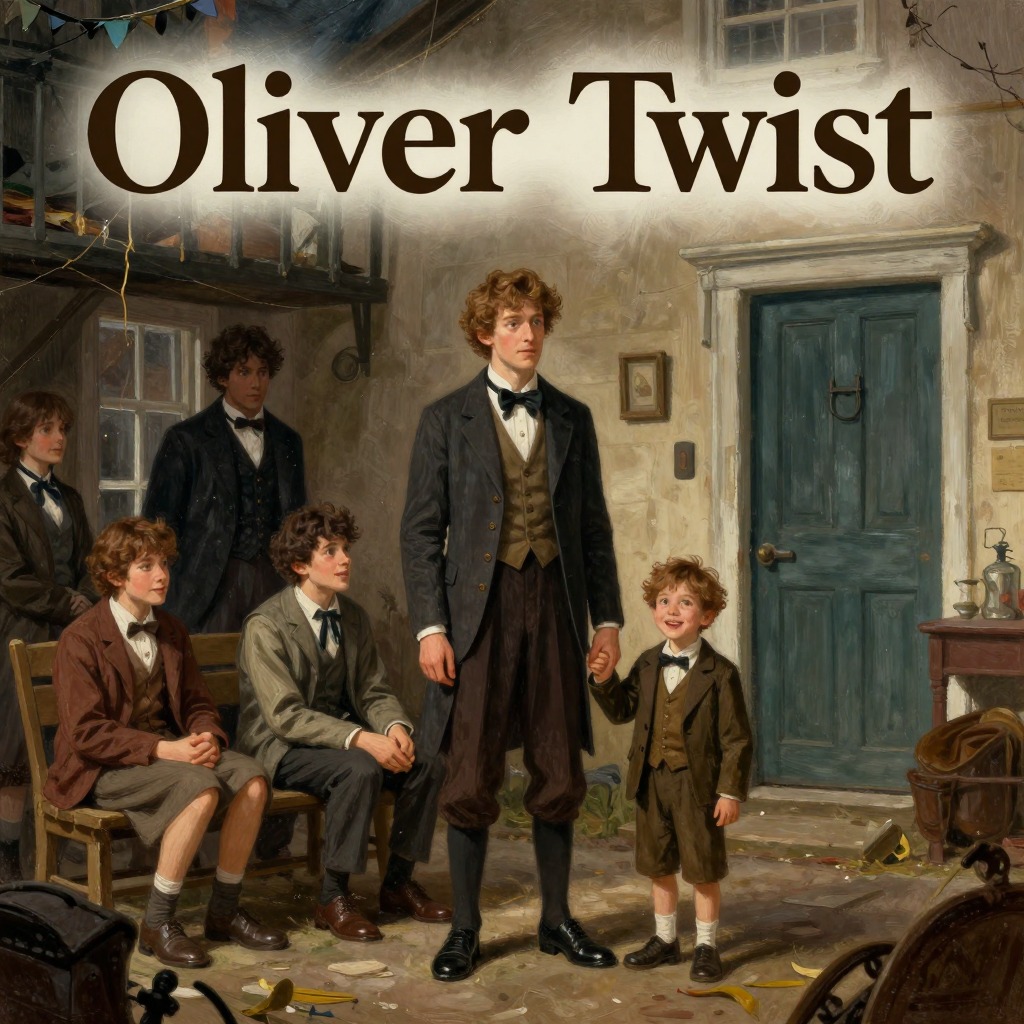
Fagin is introduced as "a very old shrivelled Jew, whose villainous-looking and repulsive face was obscured by a quantity of matted red hair," dressed in a greasy flannel gown and presiding over a room whose walls and ceiling are "perfectly black with age and dirt" . His den, located in the heart of London's most wretched district, is a training ground for young thieves, where boys like Jack Dawkins (the Artful Dodger) and Charley Bates smoke long clay pipes and drink spirits "with the air of middle-aged men" . Fagin's first act upon meeting Oliver is to grin, make a low obeisance, and take him by the hand, hoping for "the honour of his intimate acquaintance" . This grotesque hospitality masks a predatory intent: he immediately sets his pupils to pick Oliver's pockets, demonstrating that his "civilities" are a prelude to exploitation .
Methods of Control and Corruption
Fagin's power rests on a sophisticated system of psychological manipulation and economic dependency. He indoctrinates his charges through a daily game in which he dresses as a wealthy gentleman and allows the boys to practice picking his pockets, a routine that reduces theft to a sport and makes Oliver "laugh till the tears ran down his face" . When the Dodger or Charley Bates return empty-handed, Fagin "would expatiate with great vehemence on the misery of idle and lazy habits" and send them supperless to bed, once even knocking them both down a flight of stairs to enforce his "virtuous precepts" . He uses the threat of violence and the law to bind his victims, telling Oliver the story of a boy who, proving "unworthy of his confidence," was hanged at the Old Bailey, concluding with a "rather disagreeable picture of the discomforts of hanging" . The Jew's control is absolute: he has "the boy in his toils," having "prepared his mind, by solitude and gloom, to prefer any society to the companionship of his own sad thoughts" before "slowly instilling into his soul the poison" of criminality .
Relationship with Bill Sikes and Nancy
Fagin's partnership with the brutal housebreaker Bill Sikes is one of mutual self-interest laced with fear and contempt. Sikes openly despises the Jew, calling him a "white-livered thief" and an "avaricious old skeleton" , while Fagin, in turn, schemes against him. When Nancy intervenes to protect Oliver from a beating, Fagin's reaction is calculating: he first attempts to soothe her, then later, in private, contemplates how to use her growing conscience against Sikes, musing that "with a little persuasion, what more likely than that she would consent to poison him?" . He recognizes Nancy's value as a "clever girl" but ultimately betrays her to Sikes when he learns of her secret meetings with Rose Maylie, setting in motion the chain of events that leads to her murder (E03710-E03717). This act reveals the depth of Fagin's villainy: he is willing to destroy anyone, even his most valuable accomplice, to protect his own interests.
Greed and Criminal Enterprise
Fagin's primary motivation is avarice. He is a receiver of stolen goods, a "fence" who converts the boys' pickings into cash. His den is filled with silk handkerchiefs, watches, and jewelry, which he examines with "equal pleasure" . He keeps a hidden box of treasure, gloating over a "magnificent gold watch, sparkling with jewels" and muttering about the efficacy of capital punishment: "Dead men never repent; dead men never bring awkward stories to light. Ah, it's a fine thing for the trade!" . His partnership with Monks, Oliver's half-brother, is purely mercenary: he agrees to corrupt Oliver in exchange for a substantial reward, and when the plan fails, he is consumed by "mortification at the overthrow of his notable scheme" and "bitter disappointment at the loss of his revenge on Sikes" .
Downfall and Final Scene
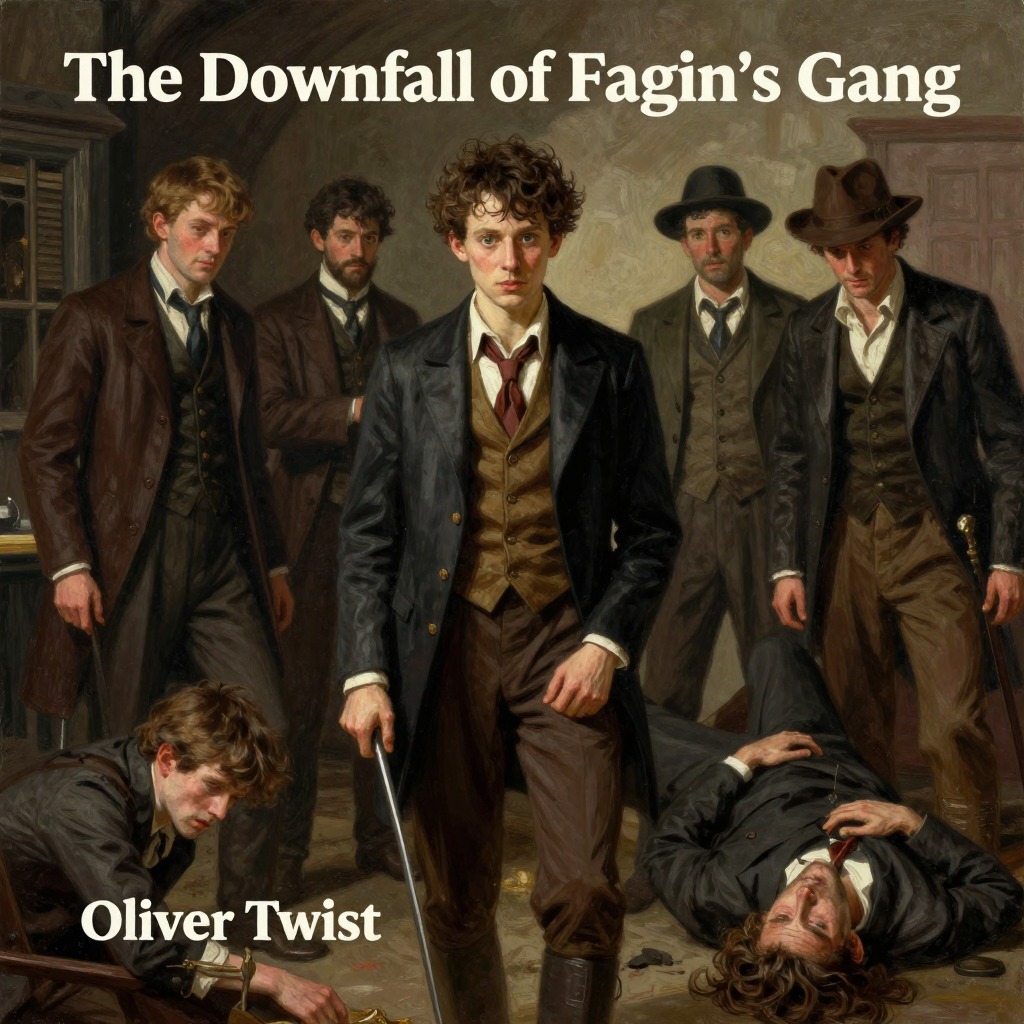
Fagin's end is one of the most harrowing in English literature. Arrested and tried, he is condemned to death. In his cell in Newgate Prison, he is reduced to a raving, terrified creature, "more like that of a snared beast than the face of a man" . He babbles incoherently, alternating between curses and pathetic appeals, and when Oliver and Mr. Brownlow visit him to retrieve crucial papers, he tries to use the boy as a means of escape, whispering, "You can get me out, if you take me so. Now then, now then!" . The final image is of Fagin being dragged away, "sending up cry upon cry that penetrated even those massive walls," while outside, the scaffold is being erected and a great multitude has already assembled to witness his execution . His death is not a moment of justice but of sheer, unadulterated horror, a fitting end for a character who has personified the predatory evil that the novel seeks to expose.